It has taken some time to reach the point of going public and sharing what I think is a different but proven approach to sourcing investment ideas. Like many people I have enjoyed the ups and downs of investing in hot tips from friends over drinks, recommendations from the experts in the press and listening to portfolio managers extol the virtues of a particular stock but only after they have filled their boots. Retail or private investors like myself are invariably the last to know about newsworthy developments and what goes on behind closed doors between companies and their large institutional audience. And I say this from a position of experience.
For the past 20 years and too many more I have worked either as an investor with companies on the Street or as an adviser to companies on their relations with the Street. What has emerged from this is an appreciation that there are a lot of smarter people than me around making decisions on publicly-traded equities and with far more resources available to do so. And that creates both a barrier and a challenge.
I could have continued my personal investing journey with working on tips that might pay off within a week or two, or not at all, but day trading has never been my thing. For every one you get right there is going to be another that goes wrong, and the key to making any money appears to be having the discipline to recognise when to take profits and accept losses.
Sitting in front of a screen worrying about whether the next movement in a share price will confirm or undermine the perceived momentum that led you to buy it seems like a life less lived than endured. Do not get me wrong. I know people who are very happy and well rewarded for playing short-term punts, however identified, and if they find satisfaction in this then well done them! But that is not and has never been my comfort zone.
As an institutional investor at the start of my career the focus was always on the fundamentals. The next quarter on a company’s earnings was less a concern than whether management had a sound strategy to make progress in delivering value longer-term. You might say fundamentals have gone out the window with the success of Amazon and Tesla as investments, but regardless of your view on these companies they are hard to ignore and not exactly the sort of jewels buried in the sand that we, as investors, are constantly looking for to offset our exposure to the casino that is the FAANGs.
So, I knew early on I was not that comfortable with quick tips. To me, both day trading and fundamental investing are about time. With day trading timing, the short-term, is crucial if you are going to make a quick buck. How many times have you had a tip, waited to buy at the market opening only for the shares to have already taken off like a rocket? Timing and opportunity are key factors in such circumstances. While fundamental investing, where I grew up and feel more comfortable, is less about timing and more about allowing sufficient time to pass for your investment ideas to take hold or not.
I am more comfortable with the notion of buy and hold with a year as being an acceptable minimum investment horizon. If a company has a bad quarter and it is just a blip that does not change the big picture then I can live with that. But if the bad quarter is a precursor to a shift in the outlook then like anyone else I may well be willing to divest.
Based on my own experience I thought there had to be a way of generating investment ideas from the actions of institutional investors. They were smarter, better resourced and had access to management of companies in a way that I and other private investors can only dream about. Could I really expect to do better than a BlackRock or Fidelity?
Statistically, even the largest and best resourced of institutional investors tend to revert to average performance over the longer-term. I will paraphrase Warren Buffett who said ‘If I could do it all over again I would just buy an ETF and retire to Florida earlier’. So, was there any point in looking at the idea generation by these powerful investment houses?
I thought it was worth a look. There were two clear variables up front that I had to decide upon. First, which investors I would monitor and analyse. They would have to share either my investment approach or horizon to some degree. If I was looking for ideas with an investable period of at least a year then I would be looking for lower turnover investors in terms of trading. So, probably every hedge fund would be out of the search process.
And second, how to extract the data I wanted. How to determine why this idea from this investment house might be the one? This seemed like the more difficult variable to come to a conclusion on but proved actually to be quite simple and embedded in my career working between companies and investors. My Magpie Hypothesis – as I tended to refer to it with anyone who would listen – was that by looking at the consensus actions of a group of highly regarded investment houses ideas would emerge statistically based on their ownership metrics. How much skin they had in the game would tell me a lot about their conviction.
If my test group were allocating more money into biotech – as was the case in 2020, surprise, surprise, on the back of the pandemic – then that is where I should be looking for ideas. And if that group were buying more shares in companies X, Y and Z then those were the specific stock ideas that I should be pursuing.
Is this fundamental investing? Not quite. I am relying on the experts to conduct the fundamental analysis. At the end of the day, I do not really need to know what the companies do or why they are being invested in. I just accept that it is good enough for my group of experts, or the tracker group as you will find I tend to refer to them as.
The specifics on all of this will be described in detail in my next posts. Suffice to say I found a process that has worked – so far – based on investing in companies from the S&P500 Index with a year long investment horizon. Buy and hold. And no FAANGs involved in the process.
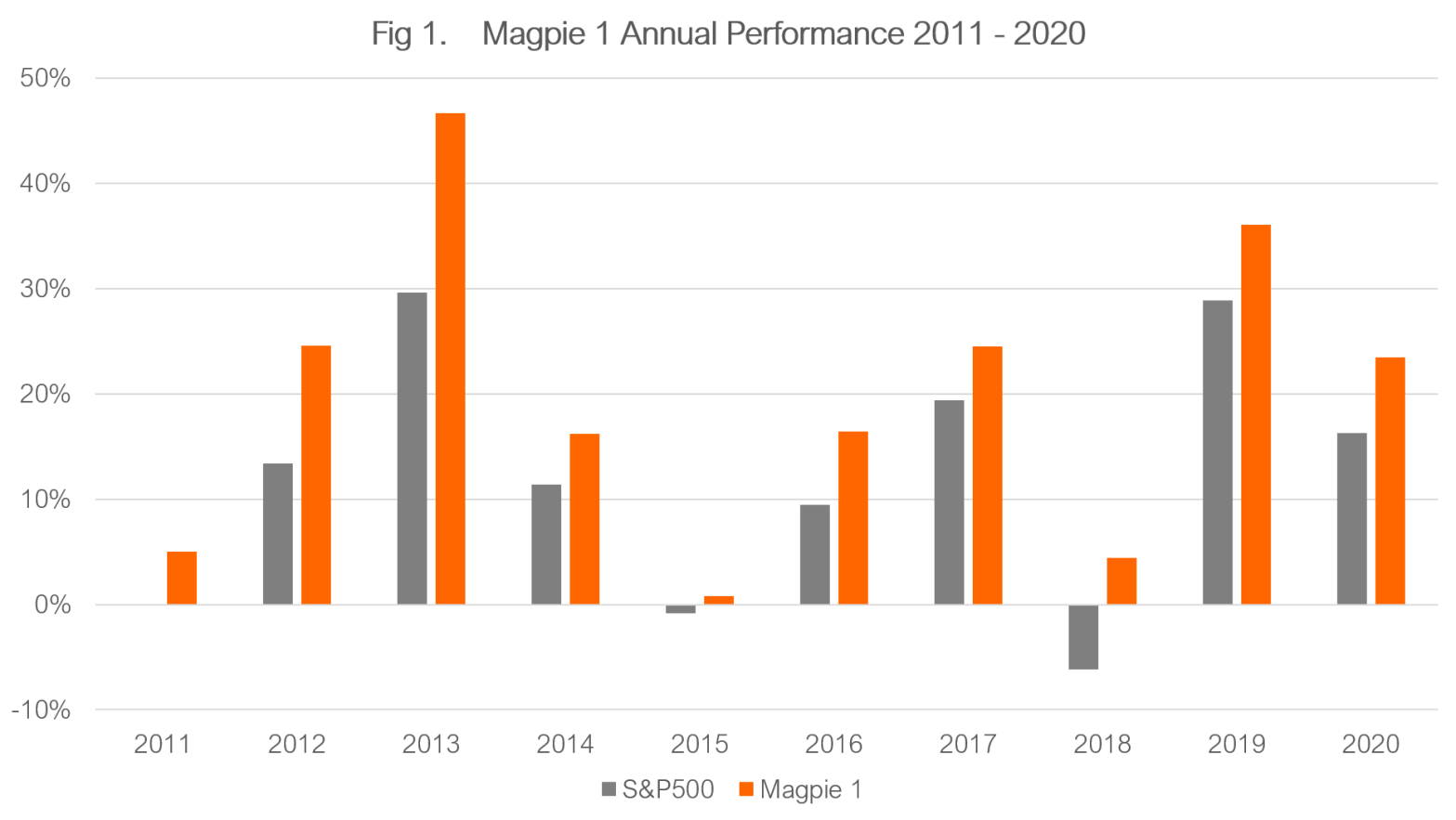
The chart below shows the performance of one variant on my hypothesis, Magpie 1, a strategy based on buying those companies my group of investors are putting their greatest faith in by taking the most significant stakes in. If an investor is buying $200 million of shares in a company that gives them a 5% stake then that is saying more about their confidence in that company than simply putting the same money into Amazon or Apple where it would barely register as a change in ownership.
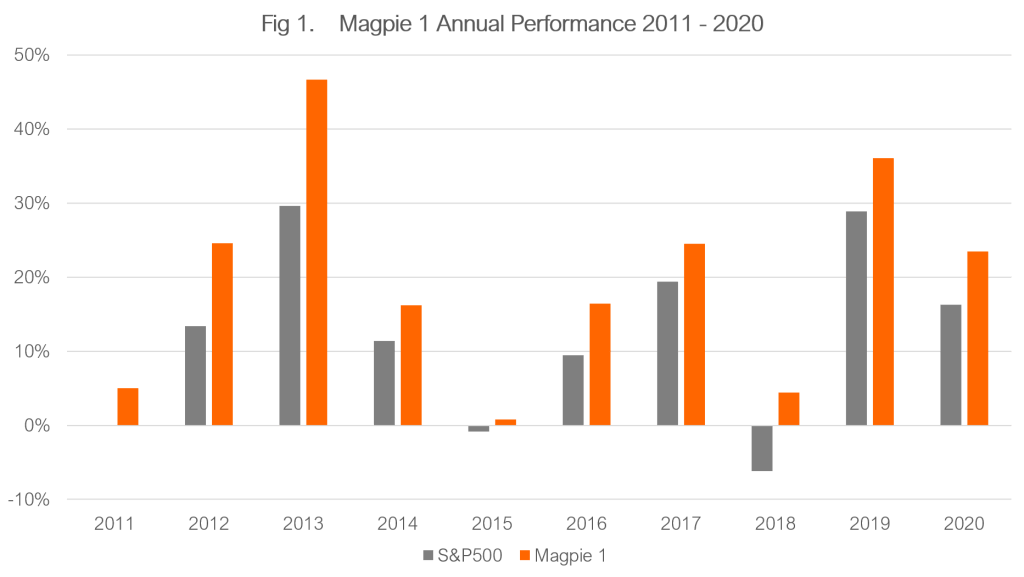
The strategy has now worked well for ten years and not once has it underperformed the S&P500 Index. It does not race away from the index but seems to generally outpace it by a comfortable margin each year. Since the beginning of 2011 the S&P500 Index had risen by 198% departing 2020 while the cumulative growth in Magpie 1 was 565%. Not bad for a sit and wait approach.
I do hope you have found this of interest and will continue to read my musings. It is my intention to share more thoughts on the process of magpie investing so that others can try it for themselves. It is also my intention to share specific stock ideas emerging from the process so that the magpie can be magpied himself!
best
The Magpie Investor
 MAGPIE INVESTOR